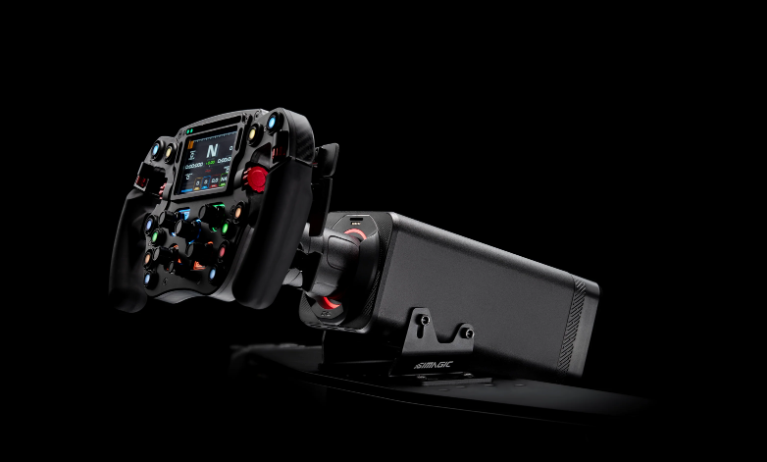
Simagic’s New Benchmark for the Premium DD Market
Simagic just raised the bar on what $969 USD buys you in a direct drive wheelbase. The Alpha EVO Ultra lands as their new flagship — 28Nm peak torque, a 5-pole servo motor, 21-bit encoder, and a patented slip ring design that quietly solves one of the most persistent annoyances in the direct drive category. This is not a spec-sheet refresh of an existing product. It’s a proper engineering step forward, and it changes some of the calculations we run when we’re configuring builds in the mid-to-upper price range.
What 28Nm and a 21-Bit Encoder Actually Mean
Peak torque gets the headline, but it’s rarely the whole story. 28Nm puts the Alpha EVO Ultra firmly in flagship territory — enough to simulate a GT3 car with proper weight through the wheel, enough to fatigue your arms through a long stint if you’re not careful with the FFB settings. That’s not a flaw; that’s fidelity.
The more interesting number is the 21-bit encoder. Encoder resolution determines how finely the wheelbase can detect and report angular position — which translates directly into how precisely it can reproduce force feedback signals. A higher bit-count encoder means the motor can react to smaller positional changes, which matters most at the on-centre position where subtle detail — road camber, tyre load shifting, the first hint of understeer — lives. Low-resolution encoders wash that information out. The 21-bit encoder in the Alpha EVO Ultra is one of the stronger figures in this price bracket.
The 5-pole motor configuration also deserves a mention. More poles in a servo motor generally correlates with smoother torque delivery across the full rotation — less step-like force, more analogue feel. Combined with what Simagic specifies as zero-cogging construction, you get a motor that isn’t fighting itself at low speeds. Cogging — the tendency of a motor to snap between magnetic pole positions — is particularly destructive to subtle force feedback detail. You feel it as a slight graininess or resistance at low torque outputs. At high speed with aggressive settings, cogging masks itself. At low speed, trying to feel the boundary of traction? It ruins it. Zero-cogging at this price point isn’t trivial.
The Slip Ring: Easy to Miss, Hard to Overprice
Buried in the spec sheet is what Simagic calls a patented slip ring design. This is worth explaining properly, because it’s one of those features that doesn’t photograph well but makes a real difference in day-to-day use.
A slip ring eliminates the cable bundle that typically runs through the centre of a wheelbase shaft. On traditional DD hubs, cables transmit button data, shifter signals, and display power from the wheel face back through the shaft to the base. Full rotations in either direction wrap those cables — which is why most wheelbases have soft or hard rotation limits. With a slip ring, the electrical connection is made through a rotating contact ring rather than fixed wires. The wheel can complete a full, unrestricted rotation in either direction without wrapping or limiting.
For oval racing, that’s immediately obvious in value. For road racing, it matters less often — but it removes a category of failure entirely. No cable fatigue, no rotation-limit nannying, no worrying about whether your wheel harness can handle the leverage a longer wheel extension applies to the exit point. It’s the kind of engineering decision that shows up in how a product holds up over three years of hard use, not just the first session.
Where $969 Sits in a Crowded Market
The premium direct drive market has become genuinely competitive, and the Alpha EVO Ultra positions itself deliberately. At $969 USD, it undercuts the Simucube 3 Sport while targeting the same buyer — someone who wants proper flagship-tier force feedback without climbing to the Simucube 3 Ultimate’s price point.
The Asetek Invicta sits in a similar range and competes directly. The Invicta is a solid piece of hardware, and Asetek has strong software support. But the Alpha EVO Ultra’s slip ring integration and the zero-cogging motor give Simagic a technical differentiation argument that’s harder to dismiss than a pure numbers comparison. The Invicta offers comparable torque figures; the Alpha EVO Ultra offers a more considered solution to the cable problem.
Against the Simucube 3 Sport, the Alpha EVO Ultra is asking you to weigh Simagic’s ecosystem and their growing software maturity against Granite Devices’ long-standing reputation for firmware precision. Simucube’s True Drive software remains exceptional. Simagic’s platform has closed the gap meaningfully over the past two years, particularly around FFB filtering and profile management. Neither is a wrong choice. But at $969, the Alpha EVO Ultra is delivering hardware specifications that were sitting in the tier above this price point a year ago.
Simagic’s Trajectory and Why It Matters
We’ve been speccing Simagic hardware into our builds for long enough to have a real view of how their products hold up — not just out of the box, but through endurance sessions. We’ve written about why we reach for Simagic and what their Zeus series introduced as a reference point. The Alpha EVO Ultra continues a clear upward trajectory from that brand: each generation has improved motor quality, encoder resolution, and software integration without ballooning the price.
That consistency matters when we’re making a recommendation to a client who’s going to live with the hardware for years. A brand that improves incrementally and predictably is one whose products hold their value in a build. Simagic has earned that status.
How the Alpha EVO Ultra Fits into Our Builds
When we’re configuring a turn-key simulator in the mid-to-upper range, we’re often balancing peak performance against the total cost of the package — because the wheelbase is one node in a system that includes pedals, motion, display, and chassis. The Alpha EVO Ultra gives us a strong anchor at the flagship wheelbase tier without requiring the client to absorb the price of a Simucube 3 Ultimate.
For clients who want genuine road-texture resolution on endurance layouts — the kind of feel that tells you what the tyre is doing at Eau Rouge at 3am during a 12-hour event — zero-cogging feedback at 28Nm is the right specification. We’ve run those sessions ourselves. We know what the hardware needs to deliver over a long stint, and the Alpha EVO Ultra’s motor architecture is built for it. The slip ring is a bonus that reduces one more point of long-term maintenance.
In our Dark builds specifically, this is the kind of component that fits without compromise — high torque, clean feedback signal, no rotation limits, and priced to leave room in the budget for the rest of the system to be specced properly.
The Bottom Line
The Simagic Alpha EVO Ultra is a serious piece of hardware at a price that used to mean something more modest. 28Nm, 21-bit encoder resolution, zero-cogging construction, and a patented slip ring — each of those is doing real work. Together, they make a compelling argument for anyone spec’ing a build in this price tier.
If you’re putting together a turn-key rig and want to understand how the Alpha EVO Ultra fits against other wheelbase options we’ve worked with — including where Simagic sits relative to Simucube across our package tiers — we’d welcome that conversation. We build around the hardware that earns its place in the system, and this one has.