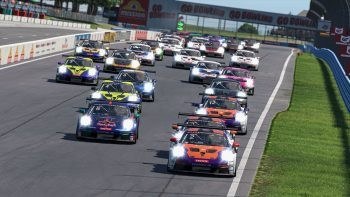
The 2026 Porsche Esports Supercup regional season has hit its midpoint, and the picture is starting to sharpen. Thirty-two drivers are still fighting across regional qualifying series for a shot at the Supercup World Championship grid, with the field narrowing race by race as regional standings separate genuine title contenders from drivers who simply got hot for a weekend. The full mid-season breakdown is worth a read if you follow the series — it’s the clearest look yet at who’s carrying form into the finale.
The World Championship Series itself kicks off September 19th at Spa-Francorchamps, which gives the regional contenders roughly six weeks to either lock up their invite or blow their shot entirely.
Why the regional structure matters
This isn’t a lobby full of fast internet strangers getting funneled into a final. iRacing built the Supercup’s qualifying pathway to mirror how the real-world Porsche Carrera Cup selects talent — regional series, consistent standings, a defined number of seats at the top. That structure is deliberate, and it’s part of what separates the Supercup from most one-make esports championships still running on a single global ladder.
It also means the mid-season numbers are more than a leaderboard curiosity. A driver who’s built a 40-point regional cushion by this point in the season isn’t chasing a hot streak — they’re managing a title. A driver clawing back from P8 has to start taking risks the leaders don’t. That tension is exactly what makes the run-in to September 19th worth watching, and it’s a big part of why the Supercup remains one of iRacing’s flagship one-make championships year after year.
The car doesn’t forgive sloppy input
The Porsche 911 GT3 Cup is not a car that rewards a heavy hand. It’s mechanically grippy but narrow in its working window — the difference between a driver holding a top-five regional spot and one fighting to stay in the top ten usually isn’t raw pace, it’s how consistently they can put the car exactly where they want it, lap after lap, without the car telling on them.
We build our rigs around the same iRacing platform hosting the Supercup, so we spend a lot of time thinking about what actually separates a podium finish from a DNF in a car like this. It’s rarely horsepower or setup tweaks — it’s pedal feel and wheel precision. A driver who can trail-brake into Eau Rouge with genuine confidence, corner after corner, for a full regional points race, is a driver whose hardware isn’t introducing noise into the input. That’s not a small thing over a 20-lap sprint format, where one bad brake application can cost the position that decides a regional championship.
What we tune for
Every turn-key build we engineer gets set up with that kind of consistency in mind — a direct-drive base with enough resolution to feel the GT3 Cup’s front end load up before it lets go, and pedals with a brake curve that lets a driver find the same threshold every single lap instead of guessing at it fresh each corner. In a spec series like the Supercup, where every driver is theoretically in the same car, hardware precision is one of the only variables left that’s actually in the driver’s control.
We’ve talked before about why turn-key simulators are the winning choice for exactly this reason — when the car is identical across the field, the rig underneath the driver becomes the differentiator that either gets out of the way or gets in it. Watching a series like the Supercup, where 32 drivers are separated by tenths across a regional table, is a pretty direct demonstration of that principle playing out at a competitive level.
The stretch to Spa
Six weeks isn’t a lot of time to change a regional standing, but it’s enough. Expect the next batch of races to get more aggressive as drivers on the bubble start racing for points instead of racing clean, and expect the leaders to start driving more conservatively to protect what they’ve built. That shift in approach is often where regional championships are actually decided — not in the fastest lap of the season, but in how a driver handles the pressure once the finish line is visible.
We’ll be following the Supercup’s push toward Spa-Francorchamps with real interest, both as racers and as the team building the rigs a lot of sim racers are training on for series exactly like this one.
If you’re spec’ing a build around the kind of precision a one-make series like the Supercup demands, we’d love to talk about how it fits into a turn-key package — book a consult or read more about how we work.