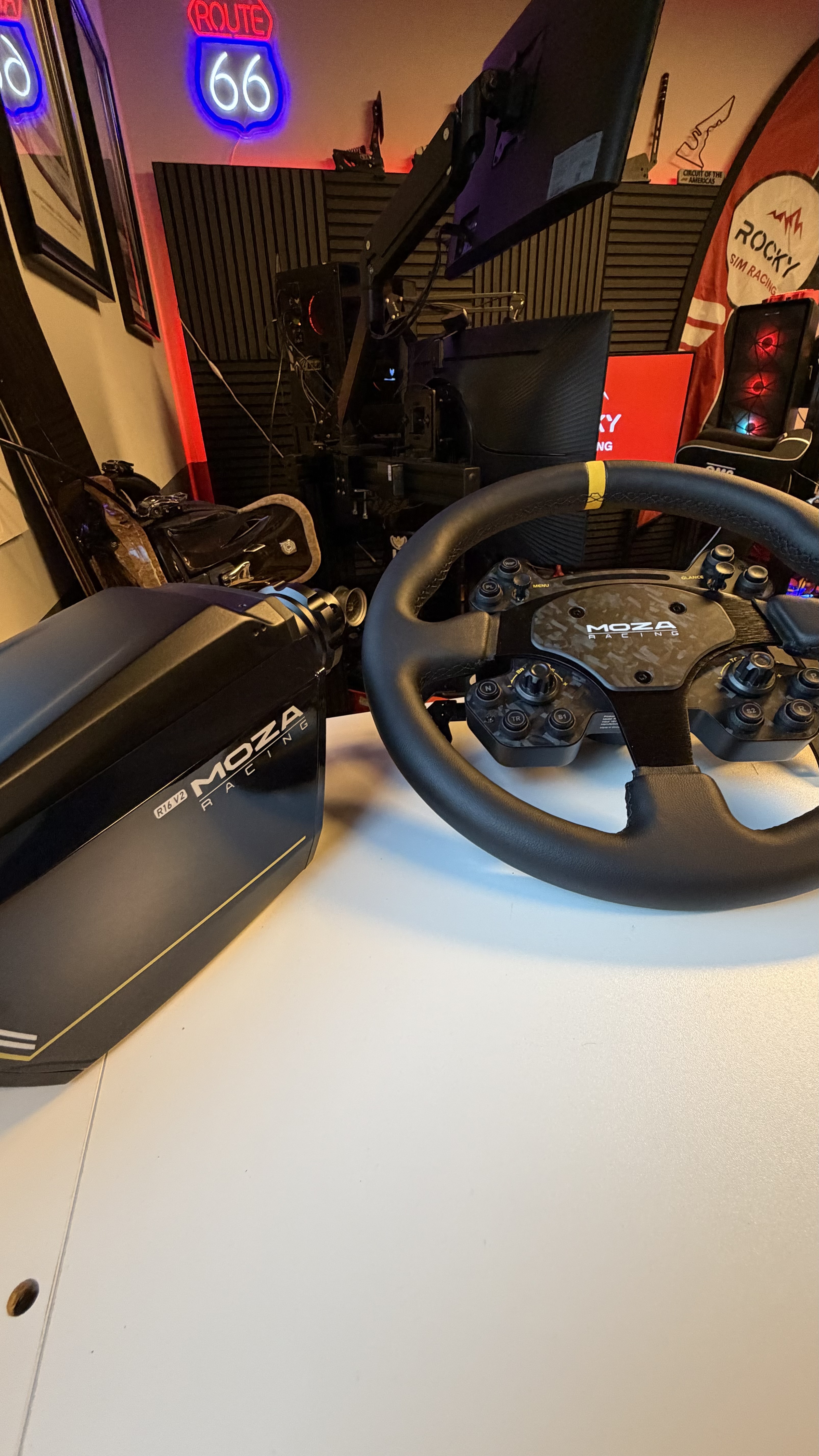
Moza’s lineup has quietly become one of the most complete direct-drive catalogs in sim racing — and Traxion.GG’s rundown of the current wheel and wheelbase range is a useful prompt to actually sort through what’s in it. Five wheelbase tiers, a wide spread of rims, and torque ratings running from entry-level to genuinely silly. The question we get asked constantly in the shop isn’t “what’s the strongest Moza base” — it’s “which one is actually right for what I drive.” Those are very different questions.
The wheelbase tiers, by who they’re for
Moza’s naming convention is blunt about torque output, which makes it easy to get seduced by the number and skip the part where you ask what you’re actually racing.
The R3 sits at the entry point — around 3.9Nm — and it’s a legitimate step up from belt- and gear-driven wheels for someone just getting into the hobby. It’s not what we’d spec into a serious build, but it’s not a toy either.
The R5 and R9 are where most sim racers actually live. The R5 lands around 5.5Nm and the R9 pushes to roughly 9Nm — enough torque to communicate weight transfer, kerb strikes, and slip angle in GT3 and touring cars without punishing your wrists over a two-hour stint. For most single-seater and endurance driving on a home rig, the R9 is the sensible ceiling, not the R16.
The R12 bridges into higher-torque territory (around 12Nm) for drivers who want more road-holding fidelity in open-wheel cars — think Formula-style aero cars with heavy self-aligning torque at speed.
Then there’s the R16 and R21, Moza’s flagship pairing, running as high as 21Nm. These are the bases that show up in spec sheets and marketing renders, and they’re genuinely impressive pieces of engineering. But 21Nm is a lot of wheel. Unless you’re running open-wheel cars at the aggressive end of the spectrum or you specifically want max-effort FFB for training purposes, most drivers will never use — or want — that much torque. We’ve had customers request the R21 by name and walk away happier with the R9 or R12 once we’ve had them drive both back to back.
Rims: the pairing decision people skip
The wheelbase gets all the attention, but the rim is what your hands actually feel, and it’s the piece most buyers treat as an afterthought. Moza’s catalog splits roughly into formula-style rims (compact, deep-dish, minimal button clusters), GT-style rims (larger diameter, more switchgear for pit strategy and multi-class racing), and button-box-oriented rims built around endurance and sim-management functions — flag callouts, ERS/DRS mapping, that kind of thing.
Get this pairing wrong and you feel it every lap. A formula rim on a GT3-focused rig leaves you without the buttons you need mid-race. A GT rim on an open-wheel setup adds bulk and weight exactly where you don’t want it for high-frequency steering inputs. This is a discipline question before it’s a preference question — what are you actually racing, most weekends, for the next year — and it’s one we walk through with every customer before a rim gets bolted to anything.
Where Moza sits against the rest of the direct-drive field
Moza’s real strength in 2026 isn’t any single wheelbase — it’s price-to-torque positioning across a market that’s gotten a lot more crowded. Simagic’s Alpha EVO Ultra now offers 28Nm around the $969 mark, and Simucube has pushed the high end further still with the 35Nm Ultimate. Against that backdrop, Moza’s tiers read as a genuinely well-thought-out ladder: you’re not stuck choosing between “cheap and underpowered” and “flagship and overkill.” There’s a sensible middle that maps to what most drivers actually need.
That said, torque-per-dollar is the wrong axis to optimize entirely on, and it’s worth saying plainly: we don’t spec hardware off a spec sheet comparison. We spec it off how it behaves on track, at race pace, after two hours in the seat.
What the spec sheet doesn’t tell you
Peak torque is the number everyone quotes and the number that matters least once you’re past the entry tier. What actually determines whether a wheelbase earns a permanent spot in a build:
-
Quick-release durability. A QR that develops play after a season of hot-swapping rims is a bigger problem than a few missing Newton-meters. This matters more in shared or multi-driver rigs than in solo home setups.
-
FFB software tuning. Raw torque means nothing if the force feedback curve is muddy or over-filtered. Moza’s Pit House software has matured a lot, but tuning it well — not just cranking overall strength — is what separates a wheel that feels alive from one that just feels heavy.
-
Long-session ergonomics. Grip material, rim diameter, and how heat-dissipating the wheel is over a 45-minute stint matter more than most buyers expect until they’re deep into an endurance race and their hands are the limiting factor, not the car.
These are the things you can’t learn from a product page, and they’re exactly why we run every wheelbase we consider — Moza included — through our own race program before it goes anywhere near a customer build.
Where this fits into an actual build
We’ve spec’d Moza hardware into several of our packages where the torque tier matches the discipline — the R9 and R12 in particular have earned their place for GT3-focused and mixed-discipline drivers who want serious fidelity without flagship pricing. It’s not the base we reach for in every tier, and we won’t pretend it is — but dismissing it because it’s not the highest number on the page would be just as lazy as buying on that number alone.
This is the whole argument for a properly engineered rig over a parts-list purchase: the wheelbase, the rim, the mounting rigidity, and the pedal setup all have to work together, tuned for the discipline you actually race. A 21Nm base bolted to a flexing desk mount with the wrong rim isn’t a better simulator than a well-integrated 9Nm setup — it’s a worse one that cost more.
If you’re weighing Moza against the rest of the direct-drive field for your own build, see how we integrate hardware like this into our builds — we’ll tell you honestly whether the flagship torque is worth it for what you actually drive, or whether a lower tier, engineered properly, will get you around the track faster. You can also browse our current simulator packages to see where each tier of direct-drive hardware lands in a turn-key build.