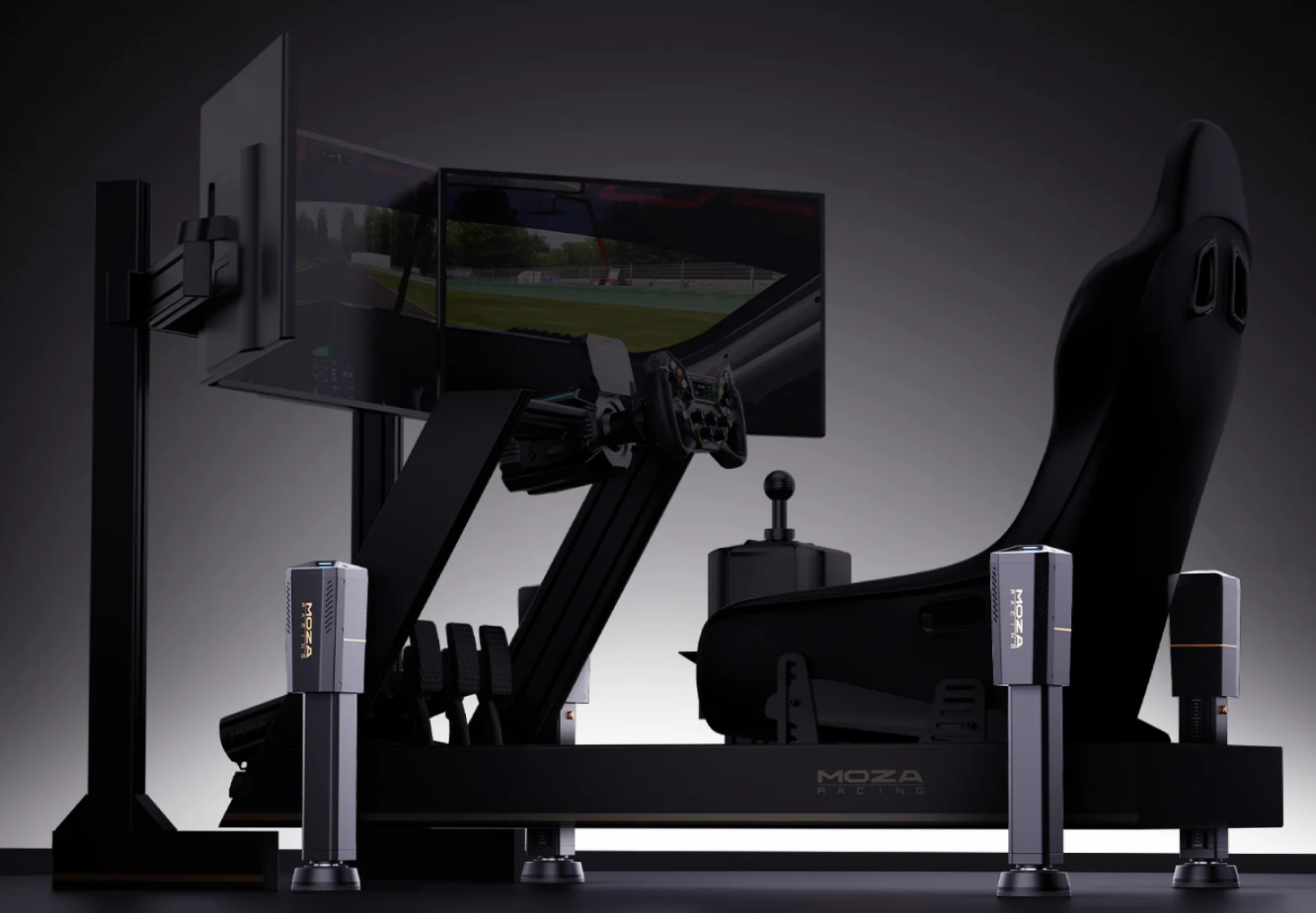
Moza Racing just dropped a hardware announcement that reshapes what “consumer” means in this hobby. The centerpiece is the HMA150, a home-cockpit motion actuator system that brings genuine platform movement — pitch, roll, heave — to a rig category that has spent the better part of a decade stuck on static setups with rumble motors bolted on and called “immersion.” Alongside it, Moza refreshed its flagship R16 Ultra direct-drive wheelbase and introduced the R5 Pro to push further into the mid-tier torque segment. The company also used the moment to show off new flight and farming-sim peripherals — a clear signal that Moza is building an ecosystem, not just a wheelbase lineup.
We track drops like this closely, and this one is worth pulling apart in three pieces: what motion actually does for a serious driver, where the R16 Ultra and R5 Pro sit competitively, and why the ecosystem push matters more than the spec sheet suggests.
Motion Is the Piece Most Rigs Are Missing
Direct-drive wheelbases solved force feedback. Load-cell pedals solved braking feel. What’s been left on the table for the average home rig is what your inner ear expects when you turn in, load the outside tires, or get stood on the brakes at 200 km/h. A static rig gives you accurate wheel torque and nothing else — your body has no idea the car is rotating until your eyes catch up.
The HMA150 is Moza’s answer to that gap, and it matters because motion actuation isn’t a luxury add-on the way it’s often marketed — it’s a consistency tool. Drivers who train on motion platforms report faster recovery from small slides because their vestibular system gets the same cue a split second before the visual cue confirms it. That’s not immersion for its own sake; that’s a measurable input channel that static rigs simply don’t have. We’ve written before about why we think motion is the missing piece in your sim rig, and Moza entering this space with a consumer-priced actuator system validates that thesis rather than undercutting it — more serious motion hardware at accessible price points is good for the whole category, not a threat to the high-end.
The caveat, and it’s one we don’t hedge on: motion is only as good as the platform it’s bolted to. A wobbly rig with a motion actuator on it will teach you the wrong lessons faster than it teaches you the right ones. If the frame flexes under actuation, the cues your body receives are noise, not signal.
R16 Ultra and R5 Pro: Torque at Both Ends of the Lineup
The R16 Ultra update positions itself as Moza’s flagship, and the direct-drive market at the top end is genuinely stacked right now — we’ve spent real time with the Simucube 3 Ultimate and put the Simagic Alpha EVO Ultra through its paces, so we’re not short on flagship torque to compare against. Where Moza has consistently differentiated is software polish and ecosystem cohesion — Pit House integration across wheel, pedals, and now motion is a genuine advantage for customers who want one dashboard instead of three.
The R5 Pro refresh is the more interesting move for our build sheets, honestly. Flagship bases get the headlines, but the mid-tier direct-drive segment is where most serious sim racers actually land — enough torque to feel every kerb and load transfer without the cost or desk-mounting demands of a 20+ Nm base. A well-tuned mid-tier base paired with a properly engineered rig will out-drive a flagship base bolted to a flexing frame every time.
Why the Ecosystem Push Is the Real Story
The flight and farming-sim peripherals might read as a footnote, but we don’t think they are. It tells us Moza is building toward being a full-motion, full-simulation hardware company rather than a wheelbase manufacturer that also sells pedals. That matters for us because our builds live or die on component quality and long-term support — we’re not interested in specifying hardware from a company that might deprioritize sim racing the moment a more lucrative vertical shows up. A broader ecosystem, done right, usually means more R&D dollars flowing back into the core product line, not less.
Where This Lands in Our Builds
We put every new direct-drive base and motion platform through our own testing before it goes anywhere near a customer rig — endurance sessions, repeated load cycles, the same abuse we put our own team’s hardware through at 12- and 24-hour events. That’s non-negotiable for a turn-key build; a component that feels great in a five-minute demo and degrades over a 20-hour stint is a liability we won’t hand to a customer.
The R5 Pro is the kind of wheelbase we’d expect to slot into our mid-tier packages once we’ve run it through that testing — it’s the right torque class for drivers who want direct-drive fidelity without flagship pricing. The R16 Ultra will get evaluated against the flagship bases we already spec in our Darkest builds. And the HMA150 is exactly the category we’ve been arguing for: motion that’s accessible enough to actually reach home cockpits instead of staying locked to professional installations.
If you’re spec’ing a build around motion actuation or a new direct-drive base and want to know how components like these hold up under real testing rather than a spec sheet, we’d love to talk about how it fits into a turn-key package — book a consult and we’ll walk you through what we’ve actually run these on. Or take a look at where motion and flagship direct-drive currently sit in our simulator packages to see how we’re building it in today.