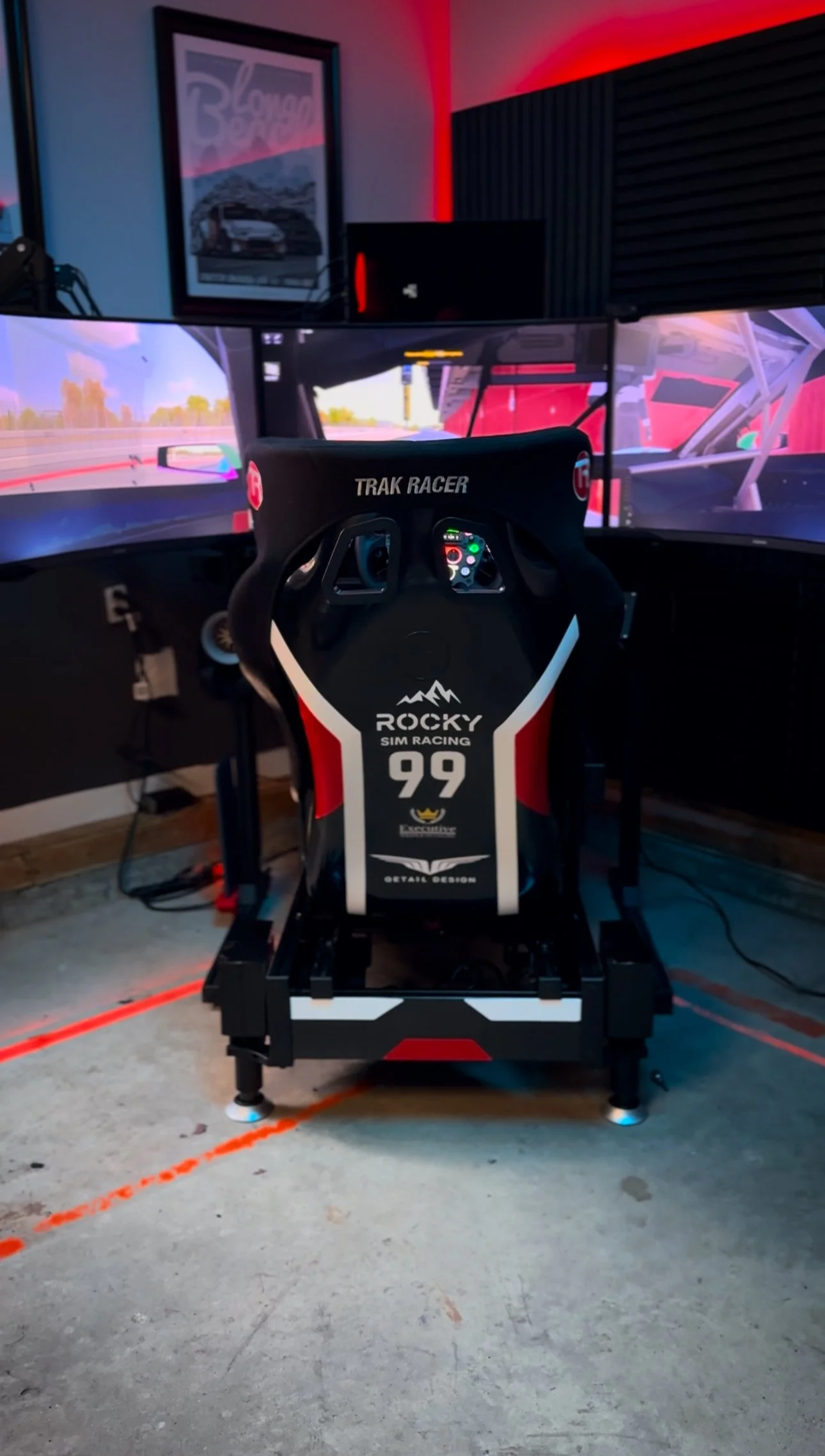
Corsair just bought Trak Racer.
If you’ve spent any time shopping for a sim rig outside the fully custom space, you know the name — Trak Racer is one of the most widely distributed cockpit and rig manufacturers on the market, sold through resellers across North America, Europe, and Australia. Now it’s owned by a $1B+ PC hardware company best known for RGB keyboards, power supplies, and gaming cases. The deal was first reported on r/simracing, and it’s worth pausing on — not because it changes what we do, but because of what it confirms about where this industry is headed.
A hardware giant just validated the category
Corsair doesn’t make impulse acquisitions. This is a company that plays in razor-thin-margin PC peripherals at massive scale, and it doesn’t add a product line unless the math says the category has legs. Sim racing hardware crossing that threshold — moving from “niche enthusiast market” to “worth a corporate acquisition” — is a bigger signal than the deal itself.
We’ve watched this consolidation trend building for a while. Asetek’s $82M sale of its SimSports division last year was the first major domino — a company that built its name on direct-drive wheelbases and load cell pedals exiting to focus elsewhere, with the sim racing assets absorbed into a larger portfolio. Corsair-Trak Racer is the same pattern from a different angle: instead of a sim racing specialist selling off, it’s a mainstream tech brand buying in. Either direction, the message is consistent — there’s real money in this space now, and the companies with balance sheets to make acquisitions are paying attention.
That’s good news in the aggregate. More capital flowing into sim racing hardware means more R&D, more manufacturing capacity, more retail shelf space, more people discovering the hobby through a brand they already trust for their gaming PC. We’re not going to pretend that’s bad for the sport.
What a Corsair-owned Trak Racer actually looks like
Here’s where we’d push back on the excitement, though. Trak Racer’s business, before this deal, was a mass-production model — tubular steel and aluminum extrusion rigs, designed for broad compatibility, sold through a reseller network, built to a price point that scales. That’s a legitimate approach, and it’s served a lot of sim racers well. It is also fundamentally a different business than engineering a simulator around one driver.
Corsair’s core competency is exactly that mass-market playbook, just bigger — supply chain efficiency, SKU proliferation, retail distribution, marketing reach. Expect Trak Racer’s catalog to get more visible, more bundled with Corsair peripherals, and probably more aggressively priced to move volume. What we wouldn’t expect is a shift toward bespoke engineering, because that’s not what this acquisition is for. Big-box hardware companies don’t buy a rig manufacturer to slow down and hand-fit components to individual drivers — they buy it to sell more units faster.
That’s the actual dividing line in this industry, and it’s one we’ve written about before when we asked why turn-key simulators are the winning choice for serious racers. A catalog rig — even a good one, even one backed by a company with Corsair’s manufacturing muscle — is still built to fit the average case. Every simulator we engineer starts from the driver: seating position, pedal geometry, motion requirements, the actual disciplines someone races. That process doesn’t scale the way a reseller SKU does, and it was never going to survive being folded into a hardware conglomerate’s product roadmap.
What this means if you own a Trak Racer rig
If you’re currently running Trak Racer hardware, the acquisition itself isn’t a five-alarm fire, but there are a few things worth watching closely over the next 12 months:
-
Support and warranty continuity. Acquisitions routinely mean support teams get restructured, ticketing systems change, and warranty terms get rewritten to match the parent company’s standard policy. Watch your renewal and warranty documentation for changes.
-
Parts availability. If Corsair consolidates manufacturing or shifts suppliers to fit its existing supply chain, replacement parts and accessories for older Trak Racer models could become harder to source — a common pattern after hardware acquisitions.
-
Product roadmap direction. Does Trak Racer keep developing its own rig lines, or does it get absorbed into a “Corsair Sim Racing” badge with re-skinned products optimized for Corsair’s retail channel? That answer will tell you a lot about long-term support for anything you buy from them going forward.
-
Pricing and positioning. Corsair has the buying power to either undercut competitors significantly or push Trak Racer upmarket to justify margin. Either move changes how the brand sits relative to the rest of the market.
None of this is unique to Trak Racer — it’s the standard playbook after any hardware acquisition, and it plays out the same way whether it’s PC peripherals, audio gear, or sim racing rigs.
Where this leaves the build decision
We don’t think this deal is bad news for sim racing. A hardware company the size of Corsair betting on this category is a sign the sport has genuinely arrived as a mainstream pursuit, not a fringe hobby. But it’s also a useful moment to be honest about what a mass-market rig — however well-distributed, however backed by corporate scale — actually is: a product built to fit as many people as acceptably as possible.
That’s not what we build. Every simulator that leaves our Calgary shop is engineered around the driver going into it, from chassis geometry through motion and force feedback, and it’s endurance-tested the same way we race it — because we compete on these platforms ourselves. That’s not a knock on catalog hardware; it’s a different category of product solving a different problem. If you’re weighing a catalog rig against something engineered specifically around how you actually drive, that’s exactly the conversation we have in every consultation. Explore what a bespoke build looks like on our packages page, or book a consult and we’ll walk you through where a turn-key, engineered-to-spec simulator fits against anything coming out of this deal.