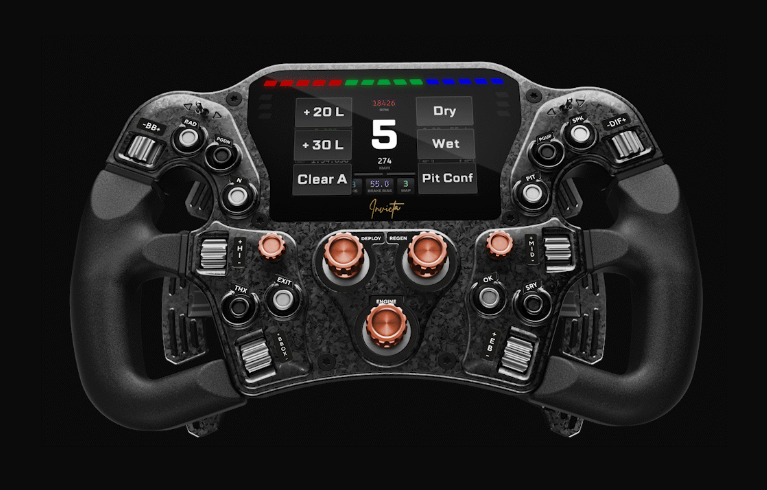
Asetek just made a chunk of cockpit hardware obsolete without shipping a single new part. A firmware update rolling out to existing Asetek Racing wheels adds a virtual button box directly onto the wheel’s integrated display — no new SKU, no add-on module, just a push update to hardware people already own.
What actually changed
Functions that used to require a dedicated physical button box — pit limiter, ABS/TC adjustment, tyre pressure readouts, engine map switching, whatever your sim of choice exposes — can now be mapped onto the wheel’s own screen. It’s the same wheel you already have mounted, just doing more work. Owners get the update for free, which is the part worth sitting with for a second: Asetek shipped new functionality into hardware that’s already bolted to customers’ rigs.
That’s not a small move. Most “new feature” announcements in this space come attached to a product launch. This one didn’t need one.
Why this matters more than it sounds like
On paper, “buttons on a screen instead of a box” reads like a minor convenience. In practice it touches three things we think about on every build we spec.
Cable routing. A physical button box means another USB run, another mounting bracket, another point of failure somewhere behind the dash. Every device you remove from a cockpit is one less thing that can work loose during a 24-hour stint or get snagged pulling a driver out for a swap. Cutting hardware out of the wiring loom is a real, tangible win for anyone chasing a clean, competition-ready cockpit — which is most of our clients.
Cost and complexity for the buyer. A good button box with proper rotary encoders isn’t cheap, and it’s one more thing to configure, calibrate, and troubleshoot. If a firmware update can absorb even half of that functionality into hardware the driver already owns, that’s real value handed back with zero purchase required.
The tradeoff nobody should skip past. Here’s where we’d push back a little. A physical button box gives you something a touchscreen fundamentally can’t: blind operation. You know where the pit limiter switch is because your thumb has found it a thousand times without looking. A screen-based control demands at least a flick of the eyes, even if it’s brief, and in traffic or in the rain in iRacing that flick matters. Rotary encoders also give tactile confirmation — you feel the click, you know the state changed. A capacitive or button-matrix display doesn’t give you that same certainty without looking down to confirm.
Our take: this is additive, not a wholesale replacement. For endurance events where every extra device is a liability, moving secondary or rarely-touched functions onto the wheel display is an easy win. But we wouldn’t pull a dedicated box for anything a driver needs to hit blind, mid-corner, under pressure — pit limiter and TC on a hot lap stay on hardware you can feel.
The bigger trend
This is part of a pattern we’ve been tracking since our piece on Asetek’s $82M takeover — the company is consolidating hardware and software into fewer, smarter touchpoints instead of proliferating peripherals. Multifunction wheel displays absorbing controls that used to need their own box is the same instinct that’s driving direct-drive wheelbases to add onboard displays, telemetry, and now UI in the first place. The wheel is becoming the control surface, not just the input device.
We expect other manufacturers to follow. It’s a firmware-level feature that adds real value to hardware that’s already sold, which is about as good as margin gets.
Where this fits in an RSR build
We spec Asetek hardware into select builds, so a change like this isn’t academic for us — it directly changes how we plan button mapping and cable routing on any rig going out the door with an Asetek wheel. Before we’d recommend a client drop a physical button box in favour of the on-wheel virtual one, we test it on the bench the same way we test everything: run the functions we’d actually assign to it, under load, in the same driving position the client will race from. If it holds up for secondary functions and doesn’t cost lap time on the primary ones, it goes in the spec. If it doesn’t, the physical box stays.
That’s the difference between a turn-key build and a parts list — someone has to actually validate that a firmware update behaves the way the press release says it does, in your cockpit, at your seating position, before it goes anywhere near a client’s rig.
If you’re spec’ing a build around Asetek hardware, or you’re trying to figure out whether a virtual button box actually replaces a physical one for your use case, we’d love to walk you through what we’ve found on the bench. Book a consult with our team in Calgary, or take a look at where Asetek gear fits across our simulator packages — we can tell you exactly which tier gets you this hardware and how we’d wire it.