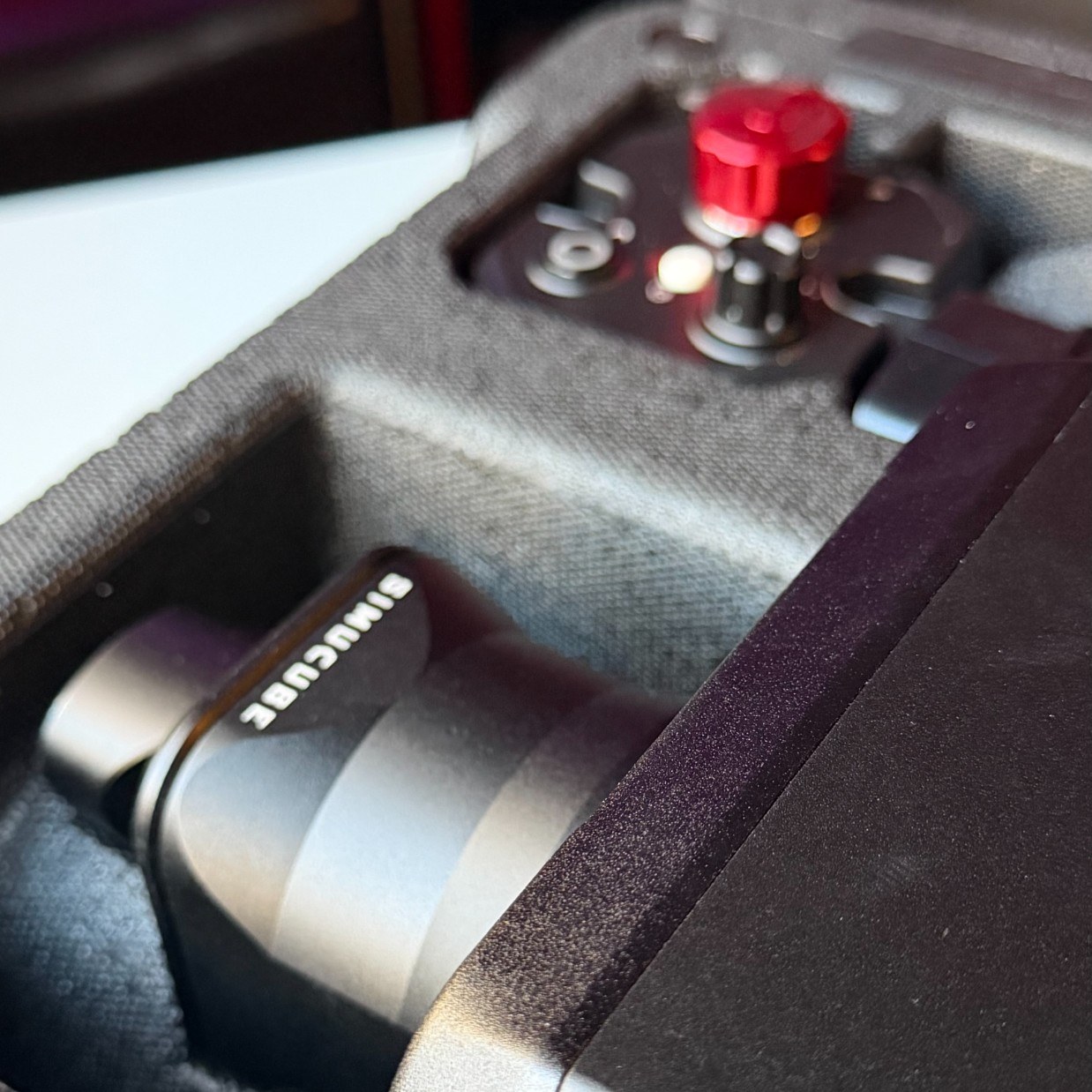
When someone on r/simracing asks how to pick between a Simucube 3 Pro, an Asetek Invicta, a Fanatec Podium DD, and a Simagic EVO Ultra, they’re not asking which wheelbase is “best.” They’re asking which 20+ Nm platform to commit to for the next five years, because at this tier you’re not upgrading again — you’re picking an ecosystem.
We get versions of this question in our shop every week. It’s the right question to be asking, and it’s also the wrong question if it’s framed purely as a spec-sheet fight. Here’s how we think about it.
What 20+ Nm actually buys you
Peak torque numbers are marketing. What matters is how much of that number you can hold, for how long, without the base thermal-throttling mid-stint or the firmware clamping torque to protect the motor.
-
Simucube 3 Pro — 27 Nm peak, built on the same True Drive ecosystem as the SC3 Ultimate we’ve already put through 24-hour racing. Torque management here is mature; SimuCUBE’s software has years of iteration behind its safety curves.
-
Asetek Invicta — the newest entrant of the four, with a reputation built on Asetek’s sim racing pedal and DD pedigree rather than years of wheelbase-specific firmware. Strong hardware, less field time.
-
Fanatec Podium DD1/DD2 — the longest continuous production run at this tier. Rock-solid QR2 ecosystem, but the ceiling on the DD2 (20 Nm) is the lowest of the four, and Fanatec’s driver stack has a history of update-related regressions that longtime owners will tell you about unprompted.
-
Simagic EVO Ultra — the value disruptor. We’ve already written about the Alpha EVO Ultra hitting 28 Nm at an aggressive price point, and the full EVO Ultra follows the same playbook: big peak numbers, younger software, and a QR system that’s still earning trust compared to Simucube’s or Fanatec’s.
The honest answer for most drivers: anything past 15-18 Nm of continuous (not peak) torque is beyond what a human forearm can process as useful information. You reach a point where more torque just means a harder hit, not more detail. The drivers who genuinely need 20+ Nm continuous are running short-course oval, high-downforce open-wheel, or big-aero GT3 cars where curb strikes and load transfer happen violently and fast. If that’s not your discipline, you’re paying for headroom you’ll spend most of your time turning down in software anyway.
The spec sheet lies without the rig around it
This is the part the Reddit thread underweights, and it’s the part we deal with hands-on every time we mount one of these into a client build. A 20+ Nm wheelbase is only as strong as what it’s bolted to.
-
Wheel deck rigidity. Bolt a Podium DD or an Invicta to a flexing aluminum-extrusion deck and you’ll feel the chassis winding up before you feel the FFB detail. We’ve had client rigs come in from other shops where the owner swore their new base felt “soft” — it wasn’t the motor, it was 3mm of deck flex eating the top end of the torque curve.
-
Bolt pattern and QR stack height. Simucube and Fanatec’s QR ecosystems are the most mature for wheel-rim compatibility; Simagic and Asetek are catching up but expect more adapter-plate shopping if you’re bringing rims from another brand.
-
PSU and cabling. These bases draw real current under load. Undersized PSUs or long, thin power runs are a common, invisible source of “my base feels weaker than the spec sheet” complaints.
-
Cooling. Sustained high-torque cornering generates heat, and thermal throttling is silent — you won’t get an error, you’ll just quietly lose Nm mid-session. Fan-cooled variants (available across all four brands at this tier) are not optional for endurance racers.
None of this shows up in a spec comparison chart. It shows up in how the base actually behaves after lap 40 of a stint, which is exactly why we test every wheelbase we spec inside the actual chassis it’s going into, not on a bench.
A practical decision framework
-
Endurance / GT racers: Prioritize thermal management and firmware maturity over peak Nm. The Simucube 3 Pro and Podium DD2 are the safer bets here — both have long track records under sustained load, which matters more over a 12-hour stint than an extra 5 Nm you’ll never hold.
-
Oval and short-course drivers: This is where peak torque and fast rise time actually matter. The Simucube 3 Pro or a well-cooled EVO Ultra make sense if you’re chasing wall-contact realism.
-
Open-wheel / high-downforce specialists: You want peak torque and a stiff wheel deck more than you want ecosystem polish. Any of the four will do it if the rig underneath is rigid enough — this is a chassis problem as much as a wheelbase problem.
-
Value-conscious drivers who still want the ceiling: The Simagic EVO Ultra gets you into 20+ Nm territory at a lower price than Simucube or Asetek, but budget time to sort QR compatibility and expect a rougher firmware update cadence.
-
Already invested in an ecosystem: If you own a stack of Fanatec QR2 rims or Simucube accessories, that sunk cost is a legitimate factor — don’t discount it just to chase a bigger peak-torque number.
Where we land
We mount and tune each of these four bases into client rigs ourselves, and the pattern is consistent: the wheelbase you pick matters less than whether the rig around it can actually deliver the spec sheet. That’s the whole premise behind why we build turn-key rather than bareback — a 27 Nm motor on a flexing deck with an undersized PSU will feel worse than a well-integrated 15 Nm setup, every time.
If you’re spec’ing a 20+ Nm build and want to know which of these four actually holds its numbers in your discipline, we’d love to talk about how it fits into a turn-key package. Our Darkest-tier rigs are built around exactly this torque class — see where each wheelbase fits across our packages before you commit five years to one ecosystem.